The Next Growth Driver for Robot Integrators:
Automating the Welding Feed
Thousands of automated welding cells still rely on manual loading. Upgrade your customers' brownfield sites and win new RFQs with Photoneo’s proven Pick-to-Weld 3D vision layer that drops into the cells you build. Fewer callbacks, fewer no-bids, and one vision system you can reuse on the next RFQ.
A Vendor Choice You Can Rely On
With 400+ Pick-to-Weld installations worldwide, when your customer asks, "Has this been done before?" the answer is yes—at scale.
Protect Margins at Acceptance
Out-of-spec bins and shiny parts are what kill project margins during commissioning. Our hardware and software handle these edge cases out of the box, so you pass acceptance the first time.
Cycle Times You Can Quote and Hit
We’ve run full pick-to-weld cycles in under 50 seconds in real US Tier-1 production. That is a proven number you can put in a proposal and defend.
Eliminate Warranty Callbacks
~85% of real-world bins are damaged beyond CAD spec. Our system detects the real bin, adapting paths dynamically to empty it fully. Fewer line stops for the customer means fewer maintenance calls to your team.
One Platform to Scale
From <2 cm bolts to >1 m body panels, standardize your vision stack once. Train your team on one toolchain, stock fewer parts, and reuse the same recipe on the next RFQ instead of re-engineering from zero.
_square.webp)
Your Biggest Brownfield Opportunity:
While the welding is automated. The feeding is not.
Across the automotive industry, plants have successfully automated the welding arc. Yet, the pipeline feeding those multi-million-dollar robots relies on an operator pulling metal from a chaotic bin.
When the manual handoff stalls, the entire automated line stalls.
This is the lowest-hanging fruit in automotive automation today. By retrofitting existing brownfield welding cells with automated Pick-to-Weld feeding, you can go back to your current customer base with a massive upgrade that delivers instant ROI.
Whether you are upgrading a brownfield site or bidding on a new greenfield cell, Photoneo provides the reliable 3D vision layer that makes the hardest part of your build the part you worry about least.
Trusted by Leading Integrators and Robotics Manufacturers
“When we have a new customer looking for bin picking or 3D inspection, our first choice is Photoneo because of the accuracy and also the wide range of hardware and software that we can add to help customers solve their applications.”
Johan Kastensson @ Sales Manager & Product Manager, OEM Automatic Sweden
“We have many different cameras from 2D to 3D, but with Photoneo 3D scanners I think it’s the best of both worlds. You can get very accurate 3D data, the object can move, you can get color and it’s all in one package. The product and the software are a very well matched package.”
Tommi Laine @ Product Manager, OEM Finland
“Point cloud quality taken from Photoneo camera is good - phenomenal - one of the best. Second thing is the wide range of product portfolio that Photoneo can provide - lots of different cameras suitable for different applications. And for these reasons we do recommend cameras from Photoneo."
Kuan Lin @ Regional Sales Director EMEA
"The satisfaction has already been on a very high level due to responsiveness. For me, this is really like a partnership. It’s not about just buying products. It’s about mutual development of the solution."
Martin Nemecek @ Robotics Manager, ABB (2009 - 2025)
Applications Photoneo Pick-to-Weld Covers
Single-Scanner Bin Picking
The workhorse for most cells. One static 3D camera with full path planning handles random, structured, and semi-structured bins.

_square%20(2).webp?width=1080&height=1080&name=BinPickingStudio_Config-07_ABB%20GoFa%20(CRB%201500)_square%20(2).webp)
Multiview Bin Picking:
Built for thin U, L, and Z parts. Multiple static 3D cameras eliminate blind spots, keeping every pick collision-free. Win back the complex geometries normally lost to a second vendor.
Rack Picking / De-racking:
Parts come off the rack cleanly - latch detection and automated unlocking included, so hanging parts are handled firmly without manual prep and without scope you have to engineer yourself.

_square.webp?width=1080&height=1080&name=Scenario-11_MediumParts_Multiview_v04%20(1)_square.webp)
Tote & Tray Picking:
Reliable picking from jumbled piles down to the last part. A repeatable pattern for presentations that don’t fit standard bins.
From Bin to Weld
Every Pick-to-Weld cell you quote lives or dies on the 3D vision. We provide a single, robust platform to handle it all.
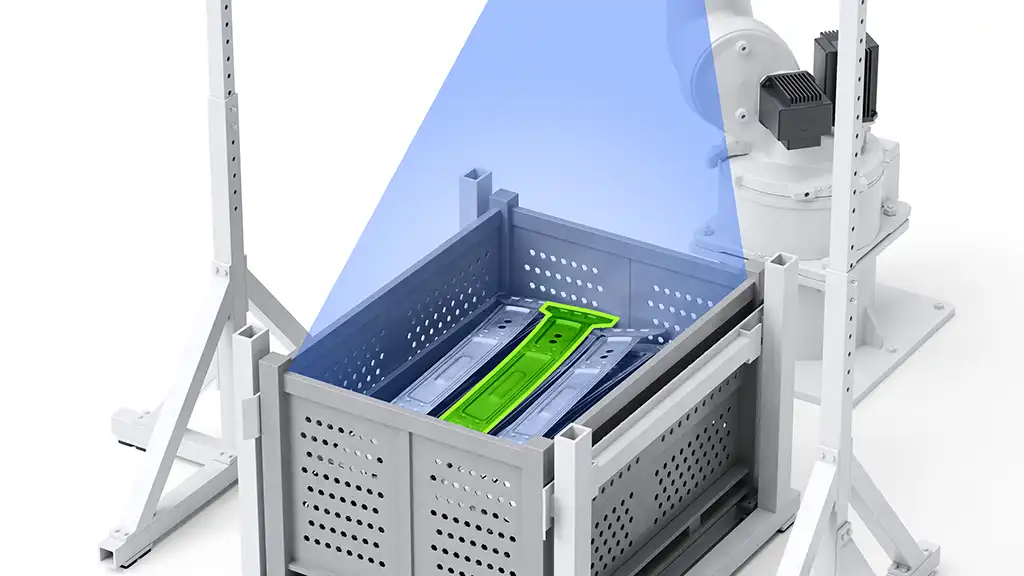
Localize (Any Part, Any Finish)
Mirror-polished aluminum or matte steel. Tiny weld nuts or massive tailgates. The system reads what is actually in front of it and identifies the right part to take first, without requiring weeks of custom tuning from your engineers.
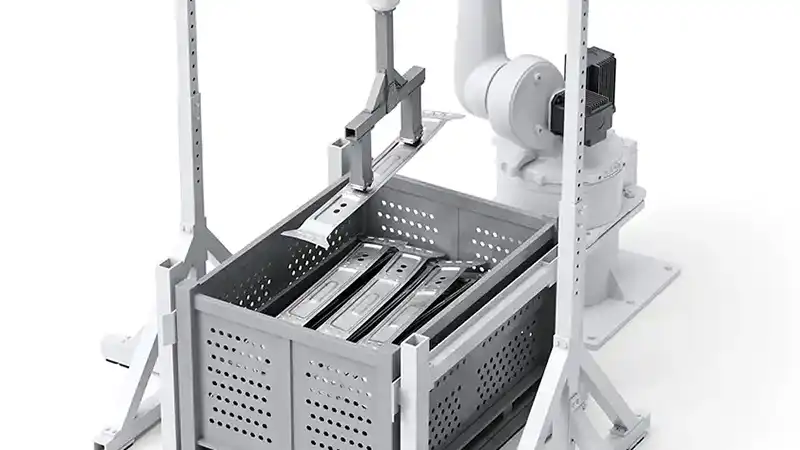
Pick (Collision-Free, Every Time)
Paths are automatically planned, not hand-taught. The robot navigates clear of caved-in bin walls and neighboring parts. If a part is wedged, built-in Aurora recovery logic works it loose instead of raising an operator call.
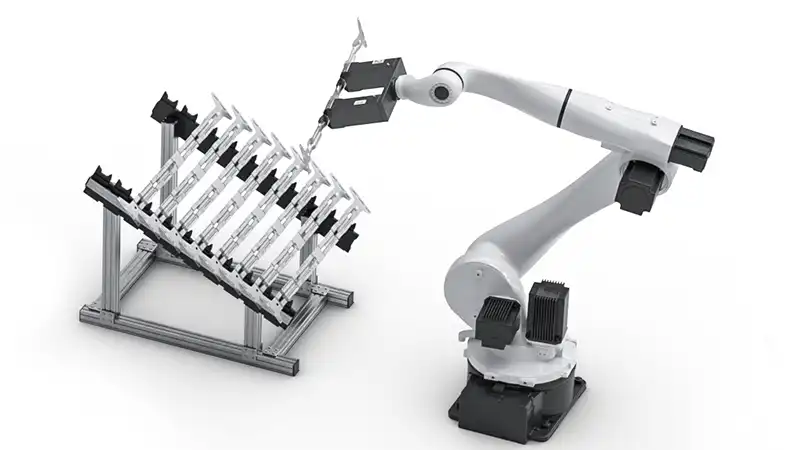
Deliver (A Clean Downstream Handoff)
The part arrives in a defined, repeatable pose, every cycle. This is where we stop and your motion begins. Whether feeding a buffer, a fixture, or the main line, you inherit a known position, ensuring your downstream welding integrates flawlessly.

Questions integrators ask us first.
Q: Will it handle our shiniest parts without weeks of tuning? Yes. PhoXi 3D Scanner Gen3 optics are built for reflective aluminum and mirror-finish steel - the surfaces that defeat ordinary sensors. It's the highest-risk variable, removed from your commissioning.ergeyr
Q: What happens when the bins are damaged and out of spec? The system detects and measures the real bin and snaps its collision models to where the bin actually is - so the cell works against reality, not a drawing. About 85% of bins in the field are out of spec; this is exactly what we're engineered for.
Q: Do we have to engineer a custom latch mechanism for de-racking? No. Latch open/closed detection and unlock are built in, along with transport-shift correction - scope you'd otherwise design and debug yourself, delivered out of the box.
Q: How much path-teaching does setup take? Far less than hand-teaching. Bin Picking Studio plans collision-free paths automatically, and Aurora Design Assistant adds empty-bin recovery - cutting programming hours and reducing operator calls after handoff. The only trajectory planning you handle leads from oriented placing (known position) to a desired place.
Q: Can one platform cover our whole range of parts and containers? Yes - under 10 cm to over 1 meter, bins to racks to nested pallets, matte to mirror. One integration pattern and one support relationship for the whole BOM.
Didn’t find your question? Drop us a message!