Exclusive Webinar: See Our Game-Changing ABB Integration in Action
Join us December 11th for an exclusive look at what happens when industry-leading 3D vision meets seamless robotic control.


Automotive safety is built on precision, data, and constant improvement. Every crash test provides valuable insights that help manufacturers design safer vehicles. However, the process of inspecting crash test results has traditionally been time-consuming and heavily reliant on manual work. This is where 3D vision technology steps in, bringing automation, speed, and unmatched data accuracy to the forefront of crash car inspection.
Let’s explore how 3D vision - powered by Photoneo’s MotionCam-3D - redefines crash car inspection and enables a data-driven approach to enhanced vehicle safety.
https://www.youtube.com/watch?v=4eC0HUn1Q0w&feature=emb_logo
3D vision is more than just capturing an image. It’s about collecting detailed spatial information to create a digital representation, aka digital twin, of real-world objects. In crash car inspection, this digital model is key for analyzing the impact of a crash and comparing it with simulation data.
Unlike traditional 2D imaging, which only captures surface-level information, 3D scanning creates a complete point cloud or polygonal mesh of the entire vehicle. This allows engineers to see the true geometry of the damage, including the depth and complexity of deformations that might otherwise go unnoticed.
Normally, 3D scanners face the tough challenge of a dynamic scene, therefore, a device able to capture objects in rapid motion is needed.
Photoneo’s MotionCam-3D stands out in this field, thanks to its unique ability to capture high-resolution 3D data in motion, a game-changer for automotive applications where speed and accuracy are critical.
MotionCam-3D's large scanning volume and high-speed capture capabilities make it ideal for synchronized area scanning, even for oversized objects or environments. This ensures highly accurate models without motion blur, enabling precise quality control, measurement, and real-time digital twinning.
Whether using Photoneo 3D Meshing or other compatible software solutions, MotionCam-3D enhances efficiency in applications requiring high-fidelity 3D reconstruction. From industrial automation to large-scale inspections.
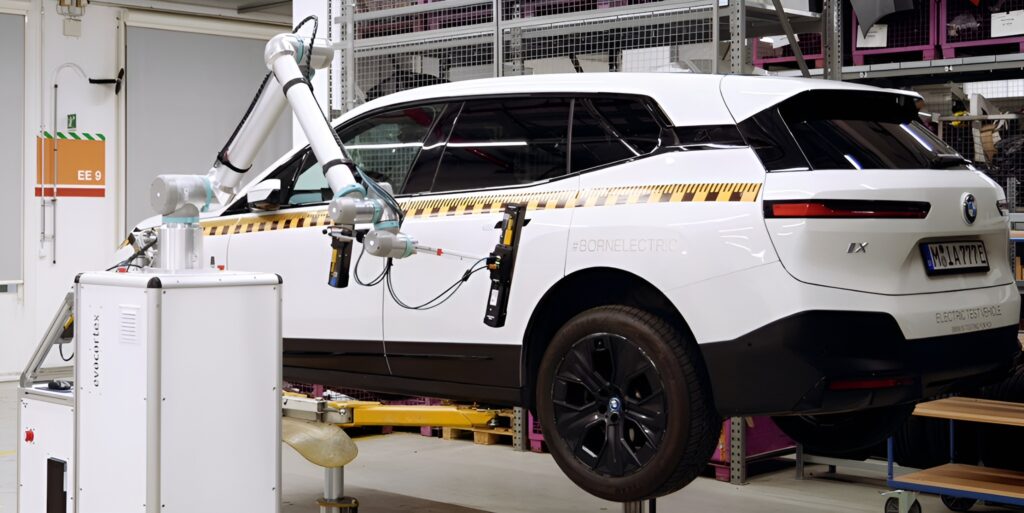
Manual inspection processes rely on handheld 3D scanners and human operators, which can lead to variability in results. Different angles, scanning speeds, or human errors can compromise the accuracy of the captured data.
3D vision technology removes these inconsistencies. With automated scanning solutions, Photoneo’s MotionCam-3D ensures consistent, high-precision data capture every time.
No two crash tests are identical. The damage can vary based on the crash angle, speed, and type of impact. To fully analyze the results, it’s essential to capture the complete geometry of the vehicle from multiple angles.
Using multiple 3D cameras in a synchronized setup allows for the capture of a full 360-degree view of the vehicle, including hard-to-reach areas beneath the car. This provides a complete digital twin of the damaged vehicle, giving engineers a holistic understanding of the crash's effects.
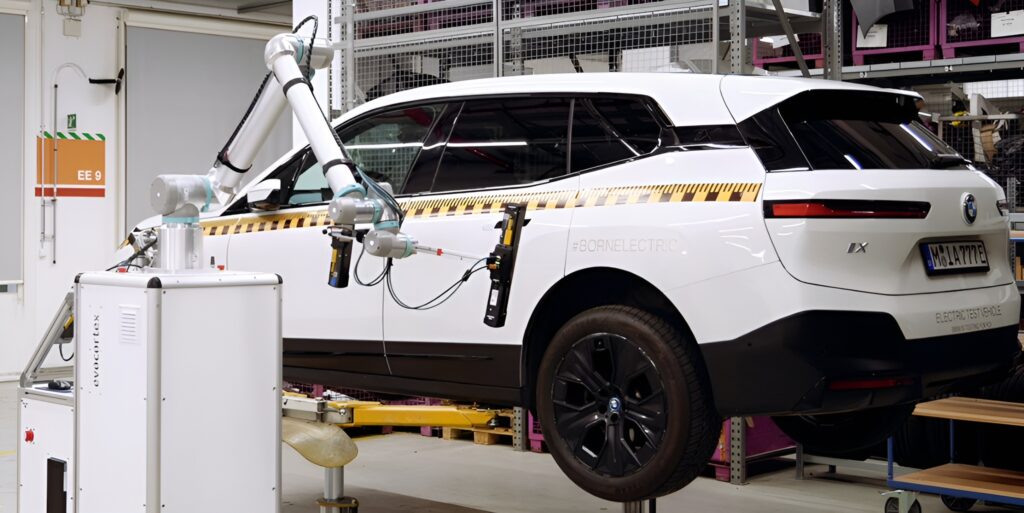
3D vision becomes even more powerful when integrated with automation technologies. In automated crash car inspection systems, 3D cameras are mounted on robotic arms and mobile platforms that move autonomously around the vehicle.
Photoneo’s 3D cameras, when paired with collaborative robots (cobots) and autonomous mobile platforms, create a highly flexible and adaptable inspection solution that:
This combination of automation and 3D vision dramatically reduces the time needed for inspections, enabling faster turnaround and higher throughput.
The true power of 3D vision lies in the data it provides. Once the crash vehicle has been scanned, the 3D data is processed and compared with the original simulated crash model.
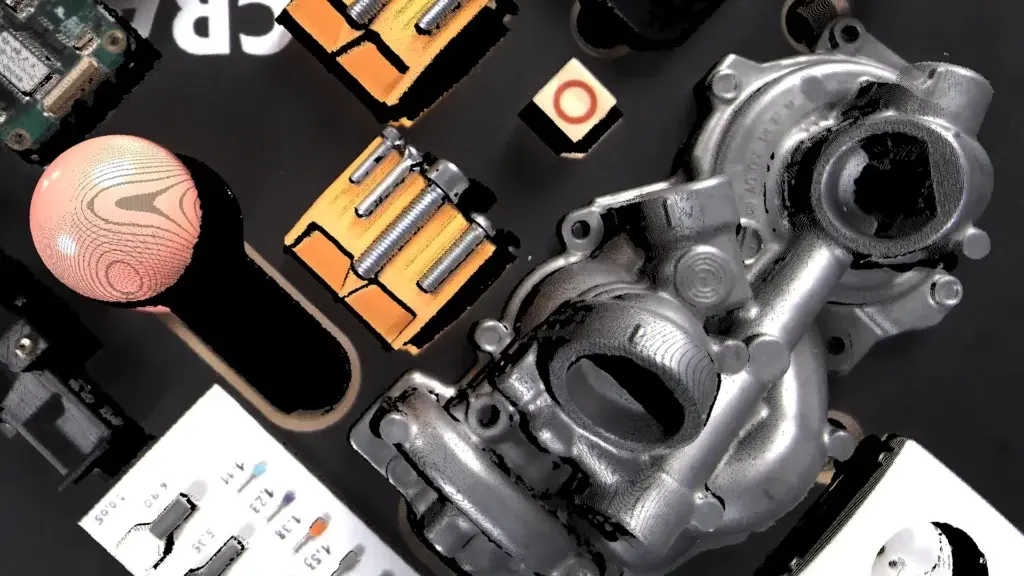
Photoneo’s MotionCam-3D Color doesn’t just capture point cloud data. It also records color information, making it easier to identify specific materials or damage patterns in the scanned model.
By comparing the scanned data to the simulation, engineers can quickly spot discrepancies, refine their simulation models, and improve future crash tests. This iterative process leads to more accurate crash predictions and ultimately, safer vehicles.
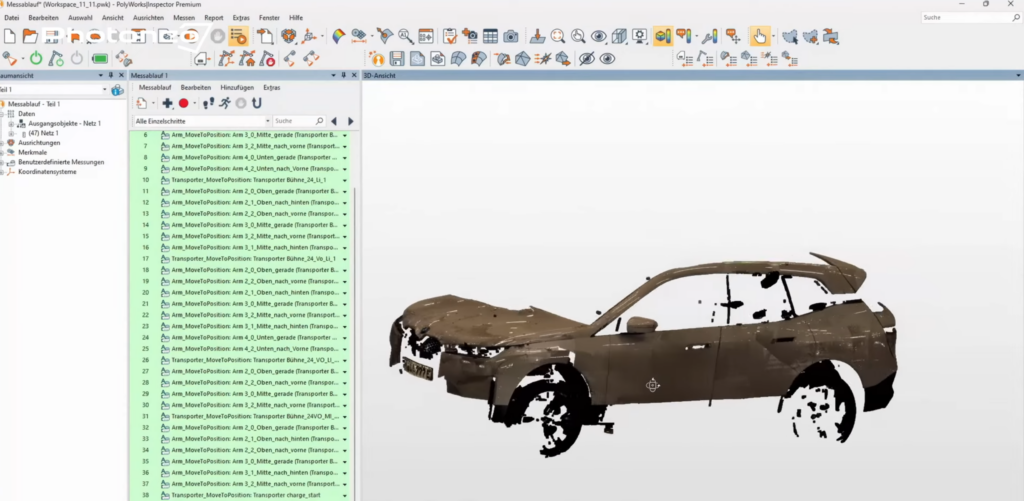
The end customer aimed to automate the crash car inspection process to boost throughput, lower costs, and enhance the accuracy of data collection for comparing real-world crash results with simulated models.
The challenge lay in the unpredictable nature of crash tests - each one is unique, with varying damage patterns that demand a highly flexible and adaptable scanning solution. Additionally, the crash test environment is filled with complexities, such as scattered equipment, debris, and inconsistent vehicle positioning, making autonomous navigation and precise scanning a technically demanding task.
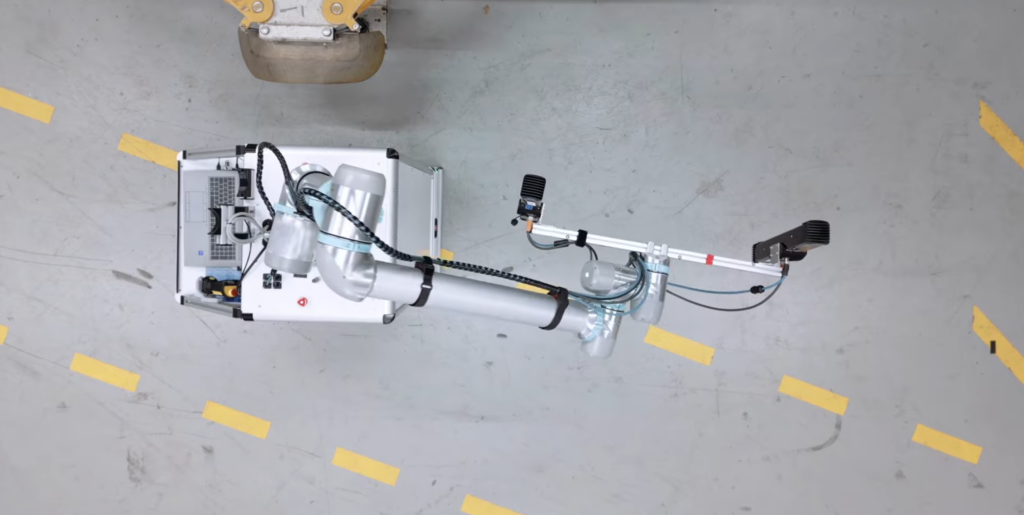
As a response, Duwe-3D, experts in 3D metrology software PolyWorks, developed RoboScan—a fully automated inspection system combining several advanced technologies:
The RoboScan process begins with the user defining a scanning sequence in PolyWorks, specifying camera positions and orientations. This automates data capture, ensuring consistency. The EvoCortex platform then autonomously navigates the crash test area, positioning the RobCo cobot arm and the attached Photoneo 3D cameras at each designated location.
The D3D++ plugin triggers the cameras simultaneously, capturing high-resolution 3D data and color information. Photoneo API ensures synchronized acquisition.
Captured data from the two cameras is automatically aligned within PolyWorks using the D3D++ plugin, creating a unified point cloud of the damaged vehicle. This scan data is then compared to the original simulated crash model. Any discrepancies revealed? Engineers are informed on areas needing improvement in the simulation.
By iterating on the simulation based on this real-world crash data, the client can improve simulation accuracy and ultimately design safer vehicles.
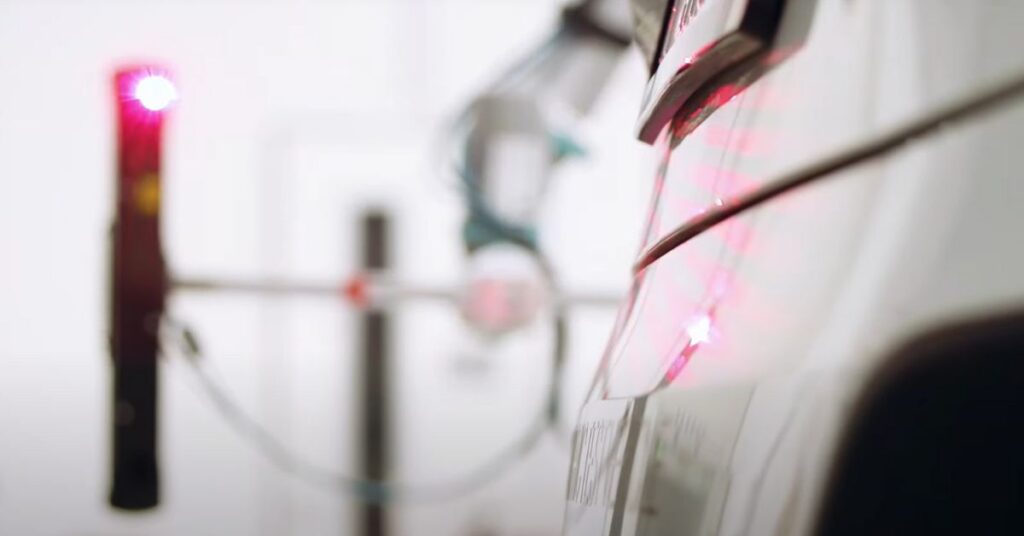
The automation of crash car inspection with 3D vision technology marks a significant leap forward in the automotive industry. By integrating high-performance 3D scanning with robotics and autonomous navigation, systems like RoboScan streamline data acquisition, reduce manual effort, and enhance the accuracy of crash test analysis.
Photoneo’s MotionCam-3D plays a pivotal role in this transformation, delivering high-speed, high-resolution 3D data that bridges the gap between physical crash tests and virtual simulations.
This innovation not only improves the efficiency and consistency of crash testing but also empowers manufacturers to design safer, more reliable vehicles based on data-driven insights. As the demand for smarter, automated solutions grows, 3D vision will remain at the forefront of automotive safety advancements.
To unlock more use cases for efficient utilization of 3D vision in automotive industry, you can download our e-book that will guide you through automating the entire production line - from press shop to general assembly.
Join us December 11th for an exclusive look at what happens when industry-leading 3D vision meets seamless robotic control.